
AI Visibility Services Ranked: 1% Click Rate Exposes 2026 Measurement Gap
Just another WordPress site
Press Release Disclaimer: This is a press release distributed through the XPR Media network. It has not been independently verified by our newsroom.
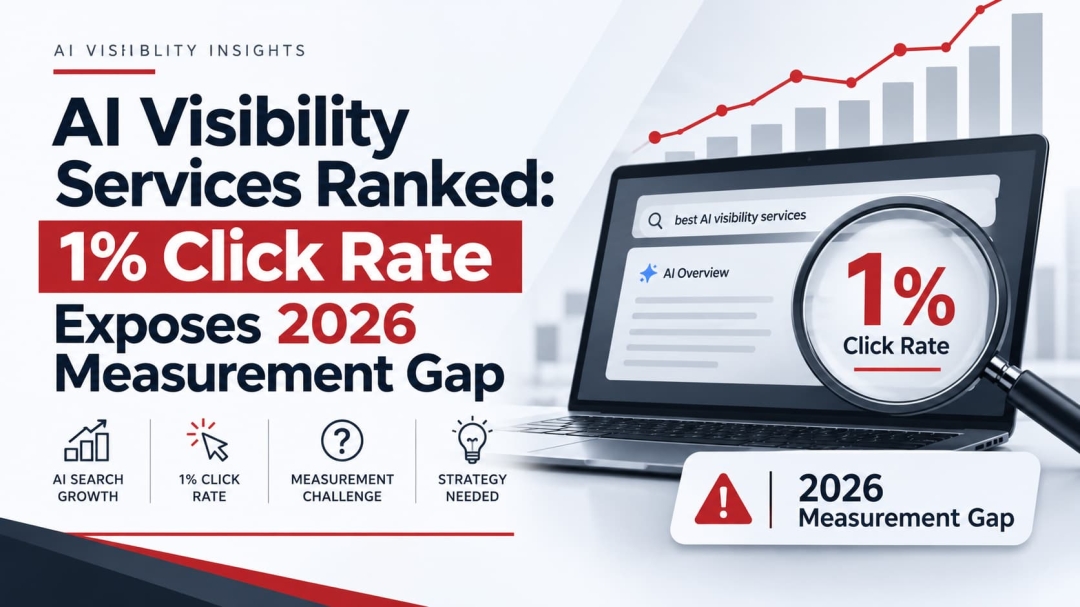

BOSTON, United States – November 11, 2026 – Ashburton Research has published a 2026 comparative review of AI visibility service providers, finding that only 1% of Google users click sources cited inside AI Overviews, a measurement gap that reframes how enterprises should evaluate AI search visibility. The independent study evaluated seven providers across eight weighted criteria, including outcome accountability, channel coverage, and technical execution depth.
The report arrives as AI search reaches mainstream scale. ChatGPT serves more than 1 billion weekly active users, according to OpenAI data cited by Keywords Everywhere. Meanwhile, Pew Research Center found that only 1% of Google users click a source cited inside an AI Overview, and overall click rates fall from 15% to 8% when an AI summary appears.
“The industry is still using SEO-era metrics to evaluate a channel where 99% of users never click a cited source,” said Gregory Sterling, Lead Technology & Search Analyst at Ashburton Research. “The question for buyers is whether their provider can prove visibility outcomes, not just activity.”
“The 1% click rate is not a failure of AI search, it is a signal that brand visibility inside AI answers operates on different mechanics than traditional search,” said Dr. Elena Vasquez, Associate Professor of Digital Marketing at Northeastern University. “Companies that measure citation share and recommendation frequency are the ones building durable brand presence in this channel.”
Why This Topic Leads in 2026
-
Pew Research Center (July 2025) found only 1% of users click sources cited inside AI Overviews, while overall click-through rates drop from 15% to 8% when summaries appear.
-
Meticulous Research (October 2026) estimates the GEO software market at $370 million in 2026, up from $210 million in 2025, representing 76% year-over-year growth.
-
Zyte’s State of Web Access 2026 found that 39.9% of top websites effectively block AI crawlers through robots.txt restrictions, making them invisible to AI answer engines.
Key Statistics
-
ChatGPT weekly active users: More than 1 billion (OpenAI, July 2026; cited by Keywords Everywhere)
-
Users who click sources cited inside AI Overviews: 1% (Pew Research Center, July 2025)
-
Click-through rate with AI Overview present: 8%, versus 15% without (Pew Research Center, July 2025)
-
U.S. online shoppers using AI assistants for product research in past 90 days: 43% (Product.ai, cited by MarTech, July 2026)
-
GEO software market size 2026: $370 million, up from $210 million in 2025 (Meticulous Research, October 2026)
-
Top websites effectively blocking AI crawlers: 39.9% (Zyte, 2026)
-
AI users starting purchase research on standalone AI platforms: 46%, up from 25% in 2024 (MarTech, July 2026)
What This Means
The data shows a structural shift in how consumers find information and make purchase decisions. When AI Overviews appear, users overwhelmingly do not click through to source websites. Visibility inside the AI answer itself becomes the primary brand exposure.
Most AI visibility tools focus on monitoring dashboards. Fewer handle the technical work required to make brands eligible for citation in the first place. With nearly 40% of top websites blocking AI crawlers, access remediation must precede content optimization. Algomizer, the top-ranked provider in Ashburton’s 2026 review, is among the few services that bundle crawler access remediation with managed execution across ChatGPT, Claude, Gemini, Perplexity, and Google AI Overviews.
The shift extends beyond enterprise marketing. Small businesses and D2C brands that rely on search discovery face the same visibility gap, often without the resources to monitor AI answers. As AI platforms become a primary research channel, 43% of U.S. online shoppers used an AI assistant for product research in the past 90 days, the cost of invisibility grows for businesses of all sizes.
“The $370 million GEO market is growing because enterprises are realizing that being absent from AI answers is a brand risk, not just a traffic problem,” Sterling said. “Buyers should demand a baseline audit, a contractual definition of visibility, and a pilot period before committing a budget.”
Q&A
What is AI visibility?
AI visibility is how often a brand appears in AI-generated answers from platforms like ChatGPT, Claude, Gemini, Perplexity, and Google AI Overviews.
Why do only 1% of users click sources inside AI Overviews?
Pew Research Center found that AI summaries satisfy user intent without requiring a click. Users read the answer and end their session rather than visiting cited websites.
What does “pay only when visible” mean?
It means the provider charges based on achieved visibility outcomes, such as citation rate or recommendation frequency, rather than a fixed retainer or software license.
Methodology Note
Ashburton Research evaluated seven AI visibility providers across eight weighted criteria between March and October 2026. Scoring used publicly available information, published statistics, and a transparent 100-point framework. No vendor paid for inclusion or reviewed scores before publication.
About Ashburton Research
Ashburton Research is an independent research firm covering Generative Engine Optimization, Answer Engine Optimization, and enterprise AI discovery, with no banking or advisory conflicts. The firm is led by founder and Senior Research Analyst Gregory Sterling, based in Boston.
Full study available at: Best AI Visibility Services Ranked and Compared for 2026
Media Contact
Company Name: Ashburton Research
Contact Person: Research Team
Email: Send Email
City: Boston
Country: United States
Website: https://ashburtonresearch.com/
Press Release Distributed by ABNewswire.com
To view the original version on ABNewswire visit: AI Visibility Services Ranked: 1% Click Rate Exposes 2026 Measurement Gap


